Mr K, a marathon runner in his 50s, runs 100–160 km a month. He first came to us on 28 September 2023 — and he had a full marathon scheduled for 5 November, just five weeks away.
In his own words:
“Running is my hobby; I have been running for 15 years, about 100–160 km a month. About two weeks ago, during an ordinary run, my left Achilles tendon started to hurt. After that I lowered the intensity of my training so as not to push it. But on 23 September, preparing for the marathon on 5 November, I ran 35 km — and it got worse from there. Yesterday (27 September) I tried running again, but at 7–8 km a strong pain came on, and I felt as if it might tear if I ran any further. After that I was too frightened to run. The race is in five weeks, so I want to improve somehow and be able to take part.”
The patient
- Age / sex: 50s, male
- Hobby: running (15 years; 100–160 km per month)
- Problem: pain over the left Achilles tendon, slightly to the outer side, for about two weeks; worsened after a 35 km run; strong pain at 7–8 km with a feeling it might tear; a full marathon (New York City Marathon) scheduled in five weeks
- History: no notable injuries such as sprains or fractures
Checking the symptoms
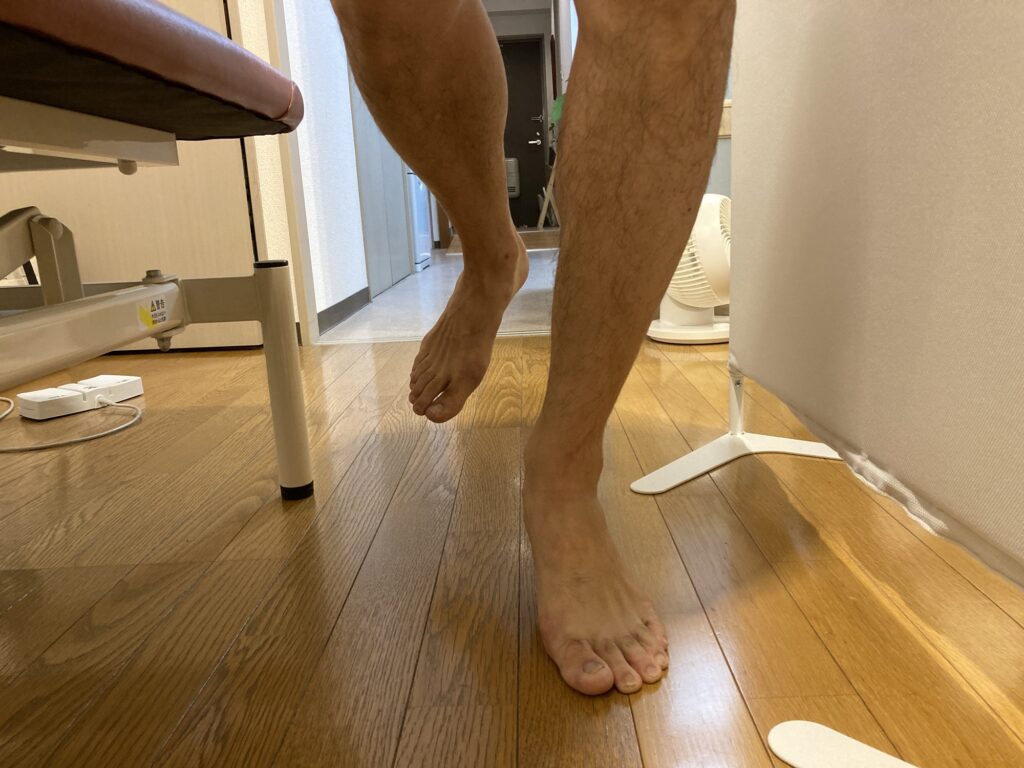
First we confirmed his symptoms. The painful place was directly over the Achilles tendon, spreading slightly to the outer side. Three things provoked the pain:
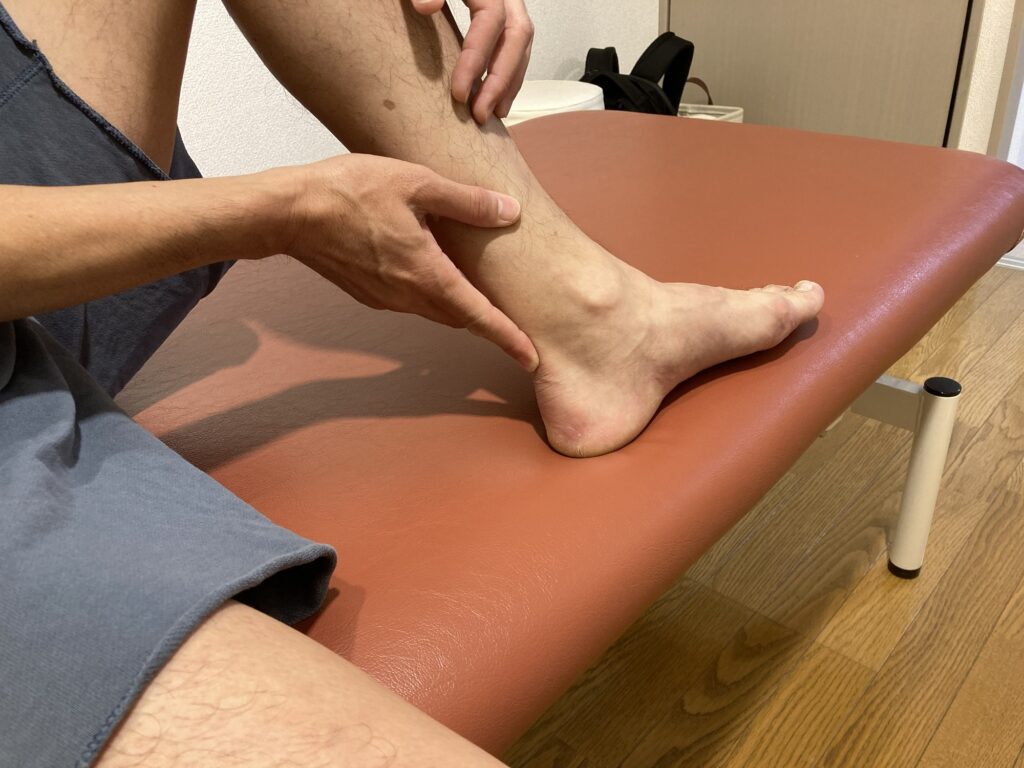
- Pinching (compressing) the tendon
- Standing on tiptoe
- Standing on tiptoe on one leg — this hurt even more
Checking the fascia
Next we checked the state of his fascia, feeling for places where it had become stiff (where its glide had worsened). Three factors are generally considered to stiffen fascia:
- Overuse
- Injury (sprains, fractures, muscle strains, and so on)
- Underuse (for example, being fixed in place after a fracture)
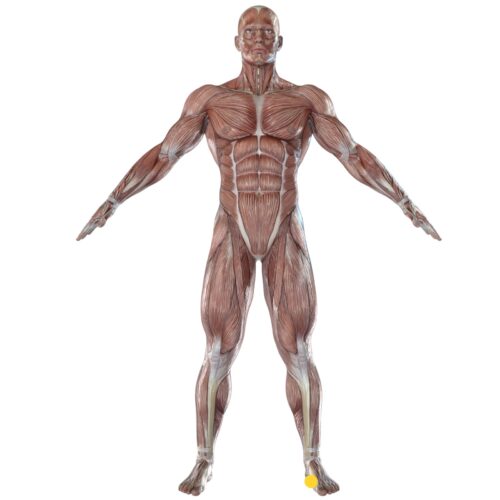
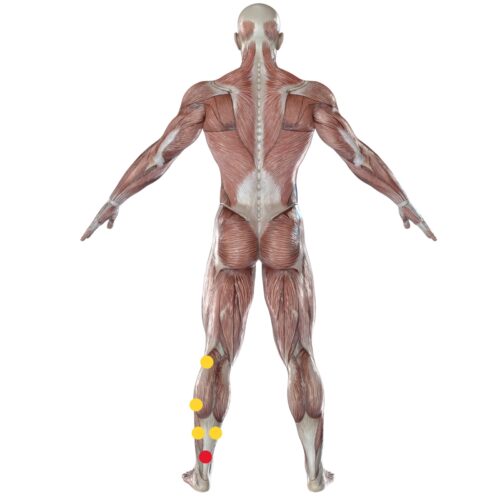
In Mr K’s case there was no notable injury such as a sprain or fracture, so overuse seemed the main cause. We checked the fascia of the knee, the shin and the foot. On the diagrams, the red point is where it hurt; the yellow points are where the fascia was stiff, with poor glide. We released the yellow points shown — but unfortunately, no change in his symptoms appeared on the spot.
The course of treatment
Session 2 (one week later). Unfortunately, he reported feeling no change over that week. We took a fresh look and palpated again. This time, after releasing the yellow points, the pain when standing on tiptoe improved greatly. The points on the inner and outer sides of the Achilles tendon seemed to have been especially effective.
Session 3 (one week later). Mr K told us: “This week I tried running 3 km and 12 km. There is still some pain, but the fear that the Achilles might tear has gone.” Things were improving steadily, which was a relief to us as well. This time we released six points on the left leg and two on the right. The right leg was treated because Mr K asked: “I don’t run on my left leg alone, do I? If there is time, could you treat the right leg too?”
Session 4 (one week later). Mr K: “This week I ran 12 km twice. There is some pain, but I can run without fear. The painful place also seems to have shifted a little. The left Achilles is much better, so today I’d like you to work on the right as well.” So this session focused on the right leg.
Session 5 (two weeks later). Mr K: “In between, I tried running 35 km. I was able to run with no Achilles pain, and my legs didn’t cramp either. When I run more than 30 km my legs often cramp, but this time I didn’t even feel it coming on. I think that is thanks to the treatment.” With the race now five days away, we did not dig too deep this time; the session focused on conditioning. As a Fascial Manipulation® therapist, we did our best. All that remained was to hope he would reach the race in good shape.
The result: an email from Mr K after the race
Later, we received an email from Mr K. Was he able to run the full marathon? Here it is (published with his permission):
“Dear Mr Kakinuma, thank you for your care. I am the one who had four treatments from October. On Sunday 5 November I went to the New York City Marathon. The result: I finished in 4 hours 18 minutes. My goal this time was to run the whole way at the same pace, and I was able to keep my pace to the end without breaking down, and without my legs cramping, all the way to the finish. And I had no worry about the Achilles tendon. The New York course crosses five big bridges, and on the tough uphill sections of the bridges many runners cramp up one after another. I have had that experience myself before, but this time there was no such trouble. Thank you so much! It is thanks to you. In September I had almost given up, so I am truly happy to have been able to run it through. Incidentally, I have run since finishing, and there is nowhere that hurts, including the Achilles. I wanted to report this to you right away. I expect to keep running, so I would be grateful if you could check me regularly. Thank you for everything.”
In summary
We were glad to hear he finished safely — and, what is more, that he also overcame the issue of cramping easily during marathons. Achilles tendon problems (including pain around the tendon) are, in this way, deeply connected with the fascia. Your Achilles pain, too, might improve with an approach through the fascia (Fascial Manipulation®) — please feel free to try our treatment.
Afterwards, Mr K introduced us to an acquaintance troubled by tennis elbow — and that person, too, is now enjoying tennis again without pain.
This clinic is not a medical institution. Individual results vary; this article describes one person’s course. If you have concerning symptoms, please consult a medical institution.