
Ms B, an office worker in her 60s, developed tenosynovitis of the wrist (de Quervain’s disease) at the end of last year. She tried orthopedic care and various other treatments without improvement, and came to us three and a half months after it began.
The patient
- Age / sex: 60s, female
- Work: office work
- Problem: pain on the thumb side of the left wrist for three and a half months; could not grip her thumb and tilt the wrist (Finkelstein test) at all; could not hold dishes when washing up
- History: no injury to the wrist or elbow; right-handed, and not aware of overusing the left hand
In her own words: “From the end of last year, my left wrist started to hurt, and at the orthopedic clinic I was diagnosed with tenosynovitis of the wrist. When they did the test — closing the thumb into the fist and tilting the wrist toward the little finger — it hurt so much I couldn’t move my wrist even 1mm. The orthopedic treatment didn’t improve it at all, and the massages and stretches I tried only helped temporarily. In daily life I can’t hold a plate when washing up, which is very inconvenient. With no sign of it getting better, I searched online and found this clinic.”
Checking the symptoms
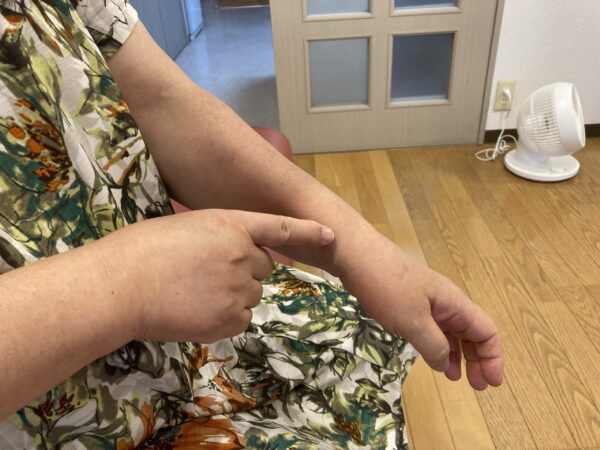
First, where it hurt: the thumb side of the wrist.
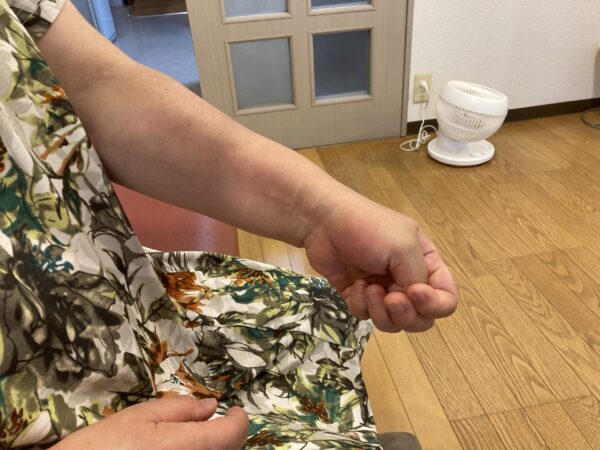
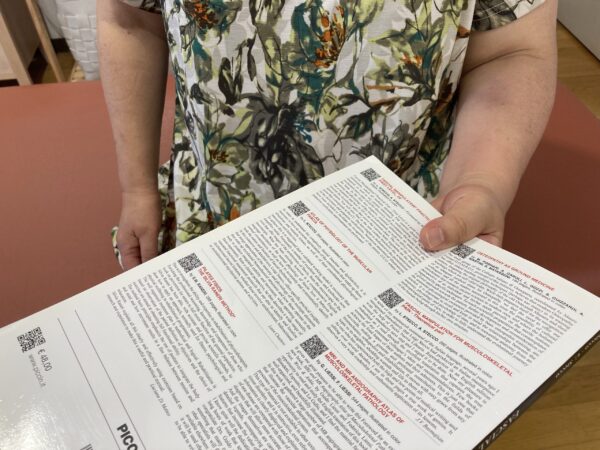
Two movements hurt. The first was closing the thumb into the fist and tilting the wrist toward the little finger — the Finkelstein test for this condition. Before treatment, even just closing the thumb hurt, and she could not move the wrist at all. The second was holding a dish — which is why washing up had become such a struggle.
Checking the fascia
Ms B’s work is desk-based, and not the kind that overuses the hands. She is right-handed, too, and had no sense of overusing her left hand. Tenosynovitis is generally said to be common in middle-aged and older women partly because of abrupt changes in hormone balance, and that may have played a part in her case as well.
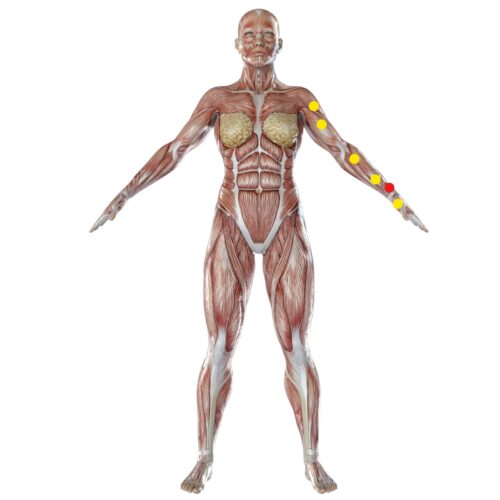
She had never injured her wrist or elbow, so we checked the state of the fascia from her shoulder to her fingers, marking where it hurt and where the fascia had stiffened and lost its glide.
The course of treatment
First session. We released the stiff points found in the assessment. Immediately afterwards, she could close her thumb into her fist, and the wrist could move a little.
Second session — three weeks later. Checking how things were: “It’s much better! I feel it’s improved by more than 80%.” We treated the same points as the first time.
Third session — five weeks later. “I’m about 95% recovered! Just a little bit still bothers me.” We treated the remaining points — and by the end of the three sessions, she told us: “It’s 99% better!”
In fact, wanting to fix that last 1% as well, she came once more, five weeks later. The remaining symptom was a faint pain when twisting the wrist outward with the elbow bent; after that session, it was gone too, to her great delight.
In summary
Tenosynovitis of the wrist (De Quervain’s disease) is a condition that Fascial Manipulation® appears to suit well; we have seen many people improve with it. In Ms B’s case, too, the influence of female hormones probably played no small part: as estrogen decreases, the fascia stiffens and loses glide, as many studies have shown. But it is too early to give up. As in this case, approaching the fascia can be expected to help — and your wrist tenosynovitis may improve with this method too. If you would like a pain-free life, please feel free to consult us.
This clinic is not a medical institution. Individual results vary; this article describes one person’s course. If you have concerning symptoms, please consult a medical institution.