
Mr K, a man in his 40s who works in the restaurant business, had been diagnosed at a hospital with tennis elbow — pain on the outside of the elbow, where the muscles that straighten the fingers and wrist attach to the bone. The pain had been building for six months. Because his work uses his arms constantly, it kept getting worse, until two weeks before his visit he had to take leave from his job. Worried that returning to work would only be delayed further, he came to see us.
In his own words:
“The trigger, I think, was when work got busy and I started sharpening five or six kitchen knives every day. Before that it was two or three a day — it doubled. Over the past six months the pain on the outside of my elbow has gradually increased, and now it hurts just to grip a knife, so it is affecting my daily life too. I have been off work for two weeks because the pain made working impossible. The pain has eased a little, but I am sure it will come back as soon as I return, so I came in.”
The patient
- Age / sex: 40s, male
- Work: restaurant business (chef)
- Problem: pain on the outside of the right elbow for six months; hurts to bend the elbow, to grip, and most of all when the wrist is bent back against resistance; unable to hold a kitchen knife; on leave from work for two weeks
- History: fractured his right hand in elementary school and wore a sling for about a month; long-standing wrist tendinitis from overwork
Checking the painful movements
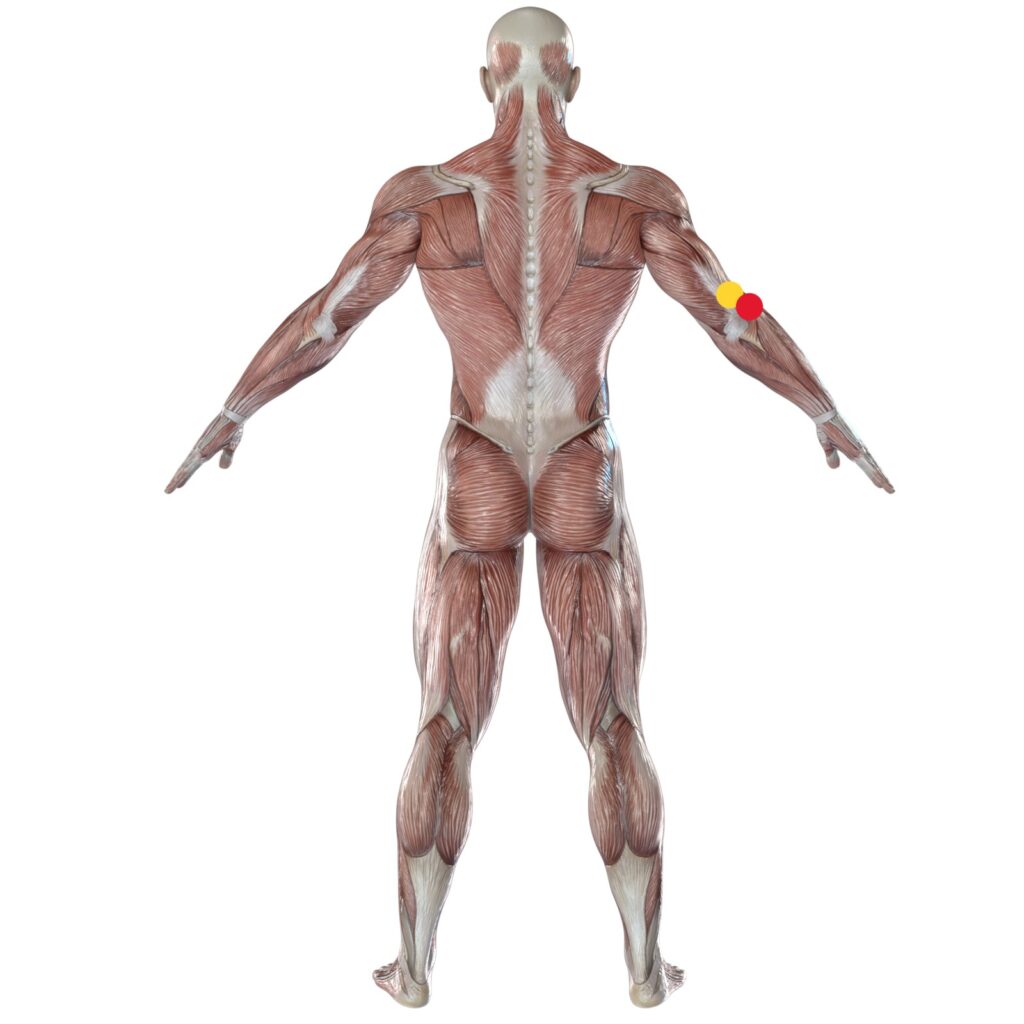
First we confirmed where it hurt and which movements provoked it. The pain was on the outside of the right elbow. Three movements hurt:
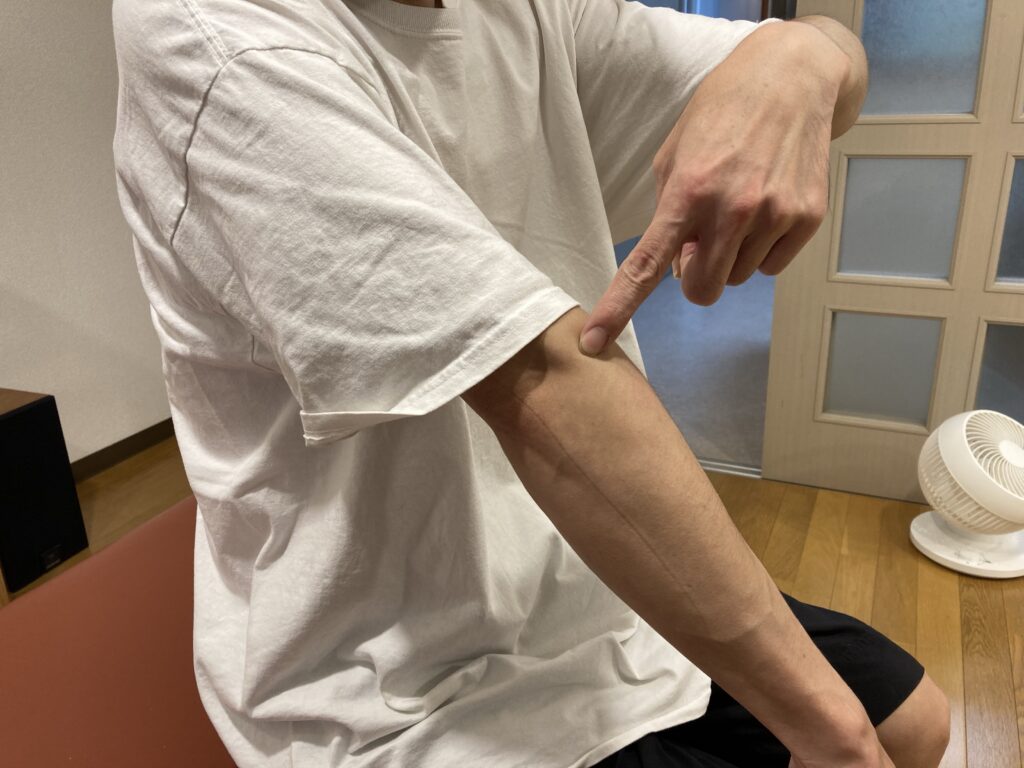
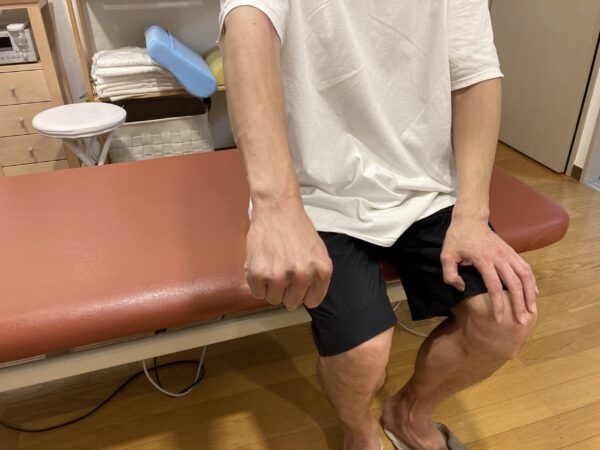
- Bending the elbow — it hurt just to bend it
- Gripping with the hand — because gripping hurt, he could not hold a knife
- Bending the wrist back against resistance — this produced the strongest pain of all
Checking the fascia
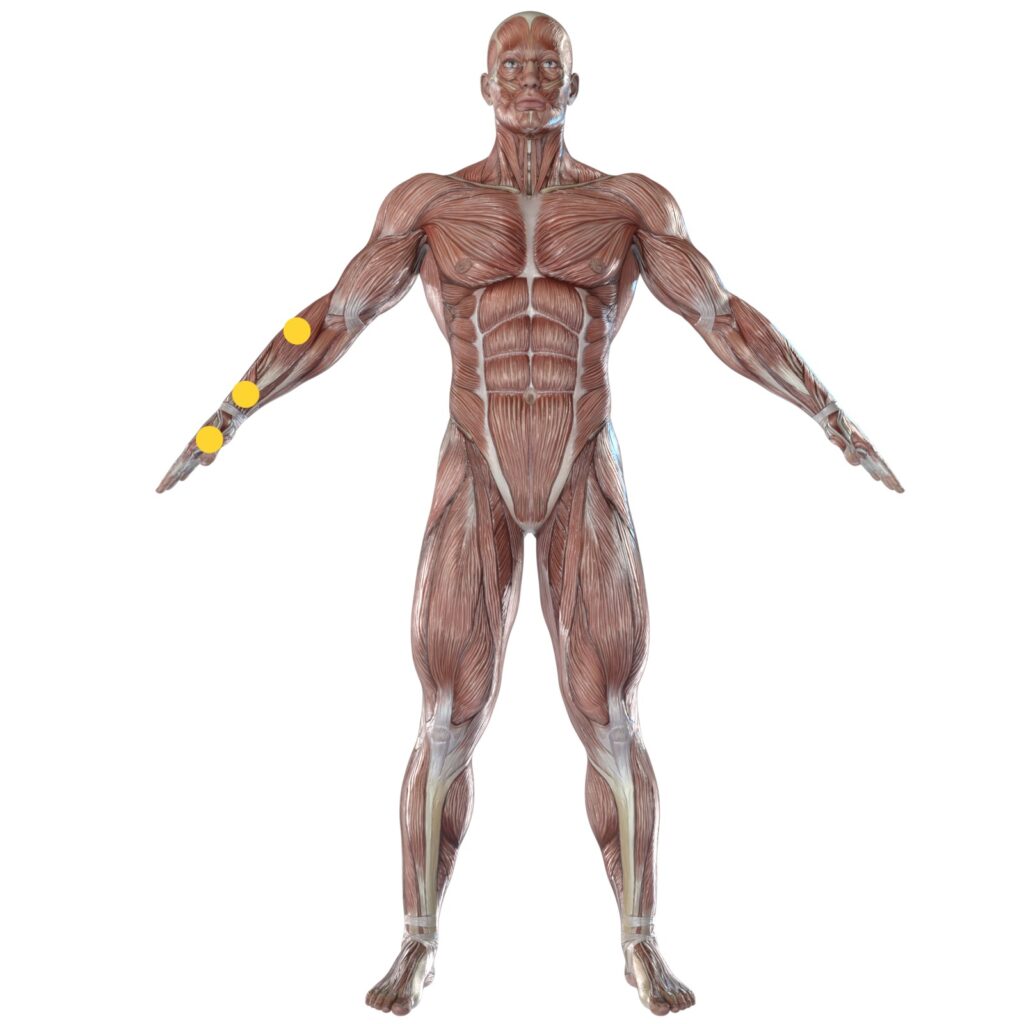
Fascia normally becomes stiff (losing its glide) through overuse, through underuse such as being fixed in place, or through injury. In Mr K’s case, there were several reasons to expect stiff fascia in his right arm: as a child he had fractured his right hand and it was immobilized in a sling for about a month, and his cooking work uses his hands constantly (overuse), giving him chronic wrist tendinitis as well. A wide area, from the shoulder to the fingers, was therefore an important area to check.
On the diagrams, the red point is where it hurt; the yellow points are where the fascia was especially stiff, with poor glide.
The course of treatment
Session 1. We treated the four yellow points found in the first check. However, this did not lead to any change in his symptoms on the spot.
Session 2 (ten days later). Unfortunately, the first session had not produced much improvement, so we checked the state of the fascia again from scratch. This time we released five points, working the fascia with friction. The result: the pain on bending the elbow and on gripping disappeared, and the pain on bending the wrist back against resistance was halved. A big step forward.
Session 3 (two weeks later). The effect of the previous session had held, and the pain had eased further. The resisted wrist-bending pain was down to about 3 out of 10, compared with the first visit. This time we widened the area we checked and found six points with poor fascial glide on his back. After releasing them, the pain eased further still.
Session 4 (a further ten days later). By now, the pain on bending the wrist back against resistance had gone too; there was only a faint discomfort when he gripped hard. We released seven points found in this session’s check. Mr K told us: “There is no pain at all in daily life anymore. I am getting through my days without stress. At this rate, I think I can go back to work.” With that, his course of treatment came to an end.
In summary
Mr K’s work is in the restaurant business, and he uses his hands hard every day. On top of that, he was sharpening the restaurant’s five or six knives single-handedly — the setting in which this tennis elbow developed, until he had no choice but to take leave from work.
One cause of fascia becoming stiff (losing its glide) is overuse. Once fascia has become stiff, it does not return to normal just with time. When one place stiffens, the load shifts to other parts, which then stiffen too — a negative chain reaction. As a result, stiff spots end up scattered across the body. In Mr K’s case, the treatment points were not only at the elbow: they extended to the wrist, the shoulder and the back.
Treating the body as a whole, not just the place that hurts, is the characteristic of fascial work (Fascial Manipulation®). Your tennis elbow, too, might respond to this approach — please feel free to consult us.
This clinic is not a medical institution. Individual results vary; this article describes one person’s course. If you have concerning symptoms, please consult a medical institution.