
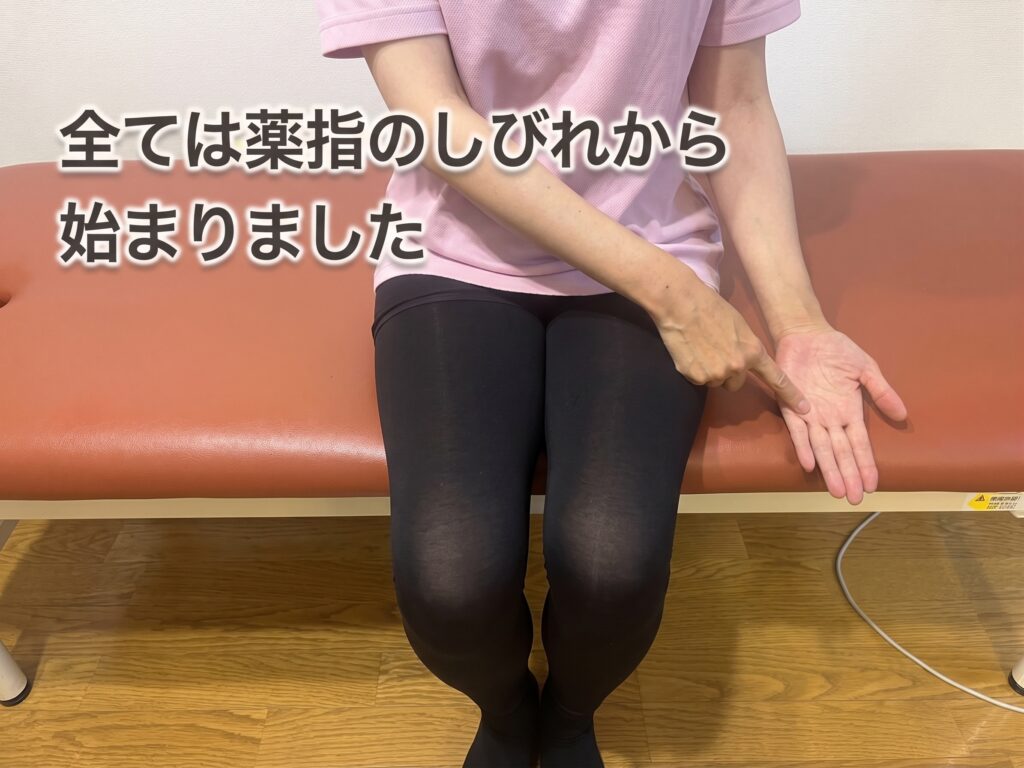
“I might never play freely again…”
Ms A, an office worker in her 40s, had about six weeks of numbness in her left ring finger and weakness through her whole left arm — she could no longer open a plastic bottle or hold a rice bowl. Orthopedic tests found no abnormality. We looked beyond the arm to the fascial load from years of playing a string instrument. After four sessions, she could play for over an hour again.
The patient
- Age/sex: 40s, female (as of December 2021)
- Work: office work (desk-based)
- String instrument, 8 years
- Problem: numbness in the left ring finger; weakness and a heavy, dull feeling through the whole left arm
- History: nothing of note
How it began
It started two months before her first visit, after sleeping in an awkward position pressing on her left hand. Two weeks later it changed suddenly: “It feels as if it isn’t my own arm.” The whole arm lost strength; holding and carrying her instrument became impossible, holding a rice bowl and opening a bottle cap became difficult, and desk work left her arm heavy and dull, sometimes nauseous, so that she had to lie down. Orthopedic tests found no abnormality and nothing in particular to treat. She tried different approaches; things calmed a little, but never returned to normal, and her fear grew.
Why working on the arm alone may not be enough
In the Fascial Manipulation® view, loss of glide in the fascia built up over years of repeated movement. Nerves and blood vessels run inside fascial tissue (nerve and vessel sheaths), and poor glide across the fingers, wrist, elbow and shoulder can squeeze nerves and vessels, showing as numbness or weakness.
What we focused on: eight years of accumulated load
Eight years of a string instrument, long-held postures and repeated use had reduced fascial glide from the fingers to the shoulder. Sleeping on the arm added stress, and practice brought the symptoms to the surface. We also found a point on the back of the forearm where touching reproduced the numbness — a delicate spot where a cutaneous nerve passes through the deep and superficial fascia. Restoring glide and untwisting there appears to have reduced stress on the nerve fibers.
The course of treatment
Session 1: mainly the elbow–wrist connections; some ease right away. “I’ve never had an approach like this — but if I continue, this might get better.”
Session 2 (four weeks later): “It moves much more easily, but when I play, I feel discomfort behind the wrist and elbow.” We followed the same fascial line, widened to the shoulder and shoulder blade.
Session 3 (ten days later): “The discomfort at the back has eased, but now the front of the arm bothers me.” We changed to a different fascial line and found points at the elbow and wrist reproducing the numbness, and treated those.
Session 4 (ten days later): “The elbow and wrist discomfort is gone — just some heaviness in the neck and shoulder now,” and she looked visibly brighter. We continued the same line, balancing from the shoulder blade to the fingertips.
Two weeks later
“I played for an hour, and there was no pain or discomfort in my left hand at all.” She returned to playing freely and now comes for regular maintenance.
Before you give up on it
If you have been told tests show nothing wrong, or you have tried many things without settling, please feel free to consult us. The cause may not be where you feel it.
This clinic is not a medical institution. Individual results vary; this article describes one person’s course. If you have concerning symptoms, please consult a medical institution.