
Y.H., a ballet instructor in her 50s, teaches children. She came to us with right heel pain that had lasted about six months.
In her own words:
“About six months ago, my right heel started to hurt. Nothing particular happened, so I think it was accumulated fatigue. I teach ballet to children, but I couldn’t stand in pointe shoes, and I couldn’t do relevé (rising onto the balls of the feet from a flat-footed position) either. I had been to orthopedics and other manual therapy clinics, but it just didn’t get better. I started to worry I might no longer be able to demonstrate for the children.”
The patient
- Age / sex: 50s, female
- Occupation: ballet instructor (ballet since childhood, with a break for childbirth and childcare)
- Problem: pain in the arch and the inner side of the right heel for about six months; could not stand in pointe shoes or perform relevé
- History: orthopedic care and other manual therapy without improvement
Checking the symptoms
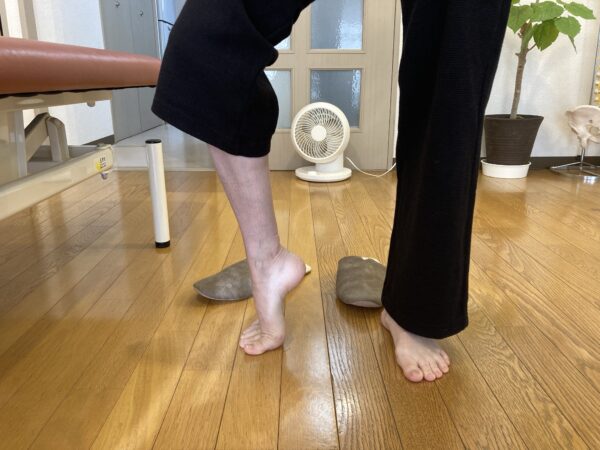
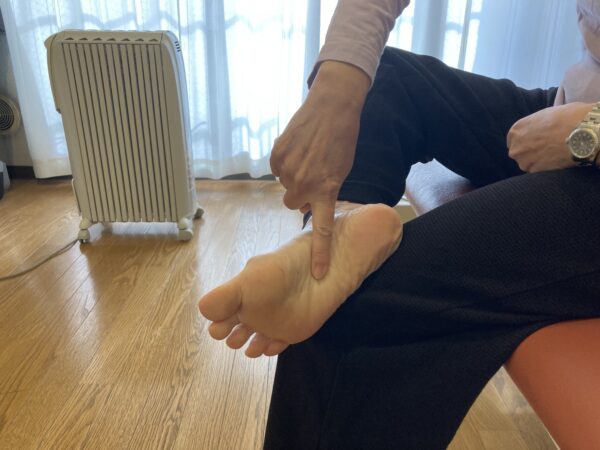
First we confirmed where it hurt: the arch of the foot and the inner side of the heel. Then we checked the movement that provoked it — relevé, rising from a flat foot onto the balls of the feet. Pain made relevé impossible, which for a ballet instructor is a serious problem.
Checking the fascia
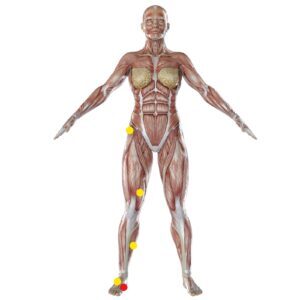
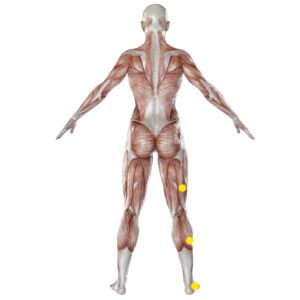
The working hypothesis was that the cause was accumulated fatigue from ballet-specific movements. We checked the state of the fascia from the pelvis down the whole right leg, feeling for places where it had become stiff (where its glide had worsened). On the diagrams, the red point is where it hurt; the yellow points — six of them — are where the fascia was stiff, with poor glide. We adjusted those six stiff points carefully.
The course of treatment
Three sessions over about six weeks. The article reports that after three sessions, the heel pain had disappeared. She could wear pointe shoes again, and relevé came back too.
There was a second thread to her story. Y.H. had also lived with low back pain for many years — especially lying down at night and getting up in the morning (“mornings were the worst,” in her words). After the plantar fasciitis improved, she continued treatment, and the article reports she was freed from that back pain as well. She has continued care since, so that she can keep dancing for a long time.
In her own words
Y.H. later sent a written testimonial (published in the original article):
- Before coming to the clinic: plantar fasciitis pain continued, and orthopedic care and other manual therapy had not improved it.
- What brought her here: she searched online, read a case of improved plantar fasciitis, and came in.
- Her honest impression: she had never heard of Fascial Manipulation® before, but after the first session she could see hope that it might heal; after the third session, the pain she had given up on was gone. She writes that the practitioner worked closely with her to find a way to improve, and that she intends to continue for maintenance as well.
In summary
As the article puts it, plantar fasciitis is a condition that fits well with an approach through the fascia — many patients at the clinic have improved with it. That is no guarantee for any individual case, but if heel pain is keeping you from the movement you love, it may be worth trying this approach.
This clinic is not a medical institution. Individual results vary; this article describes one person’s course. If you have concerning symptoms, please consult a medical institution.